Examples and Comparison of Algorithms
Let’s see some examples for learning to use pyrimidine.
Example 1
A simple example — Knapsack problem
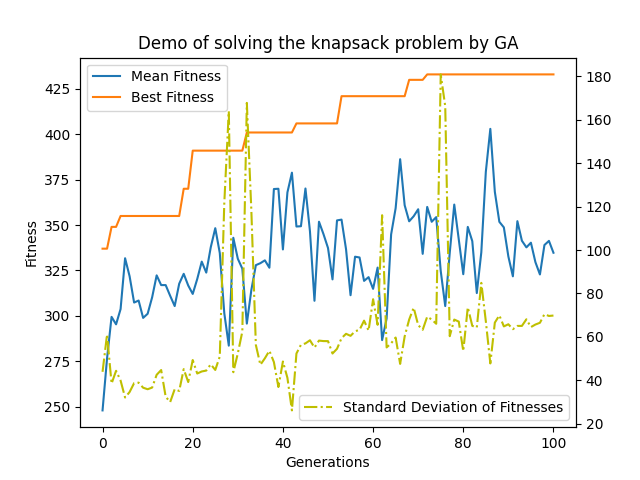
One of the well-known problem is the knapsack problem. It is a good example for GA.
Codes
#!/usr/bin/env python3

"""
An ordinary example of the usage of `pyrimidine`
"""

from pyrimidine import MonoIndividual, BinaryChromosome, StandardPopulation
from pyrimidine.benchmarks.optimization import *

from pyrimidine.deco import fitness_cache


n_bags = 50
_evaluate = Knapsack.random(n_bags)  # : 0-1 array -> float

print(_evaluate.w)

# Define the individual class
@fitness_cache
class MyIndividual(MonoIndividual):

    element_class = BinaryChromosome.set(default_size=n_bags)
    def _fitness(self) -> float:
        # To evaluate an individual!
        return _evaluate(self.chromosome)

# Equiv. to
# MyIndividual = (BinaryChromosome // n_bags).set_fitness(_evaluate) @ fitness_cache


# Define the population class
class MyPopulation(StandardPopulation):
    element_class = MyIndividual
    default_size = 20

""" Equiv. to
    MyPopulation = StandardPopulation[MyIndividual] // 20
    or, as a population of chromosomes
    MyPopulation = StandardPopulation[(BinaryChromosome // n_bags).set_fitness(_evaluate)] // 8
"""

pop = MyPopulation.random()


if __name__ == '__main__':

    # Define statistics of population
    stat = {
        'Mean Fitness': 'mean_fitness',
        'Max Fitness': 'max_fitness',
        'Standard Deviation of Fitnesses': 'std_fitness',
        # 'number': lambda pop: len(pop.individuals)  # or `'n_individuals'`
        }

    # Do statistical task and print the results through the evoluation
    data = pop.evolve(stat=stat, max_iter=100, history=True)

    # Visualize the data
    import matplotlib.pyplot as plt
    fig = plt.figure()
    ax = fig.add_subplot(111)
    ax2 = ax.twinx()
    data[['Mean Fitness', 'Max Fitness']].plot(ax=ax)
    ax.legend(loc='upper left')
    data['Standard Deviation of Fitnesses'].plot(ax=ax2, style='y-.')
    ax2.legend(loc='lower right')
    ax.set_xlabel('Generations')
    ax.set_ylabel('Fitness')
    ax.set_title('Demo of solving the knapsack problem by GA')
    plt.show()
Visualization
For visualization, just set history=True in the evolve method. It will return DataFrame object. Then draw the data by the methods of the object.
import matplotlib.pyplot as plt
fig = plt.figure()
ax = fig.add_subplot(111)
ax2 = ax.twinx()
data[['Mean Fitness', 'Best Fitness']].plot(ax=ax)
ax.legend(loc='upper left')
data['Standard Deviation of Fitnesses'].plot(ax=ax2, style='y-.')
ax2.legend(loc='lower right')
ax.set_xlabel('Generations')
ax.set_ylabel('Fitness')
plt.show()
Another Problem
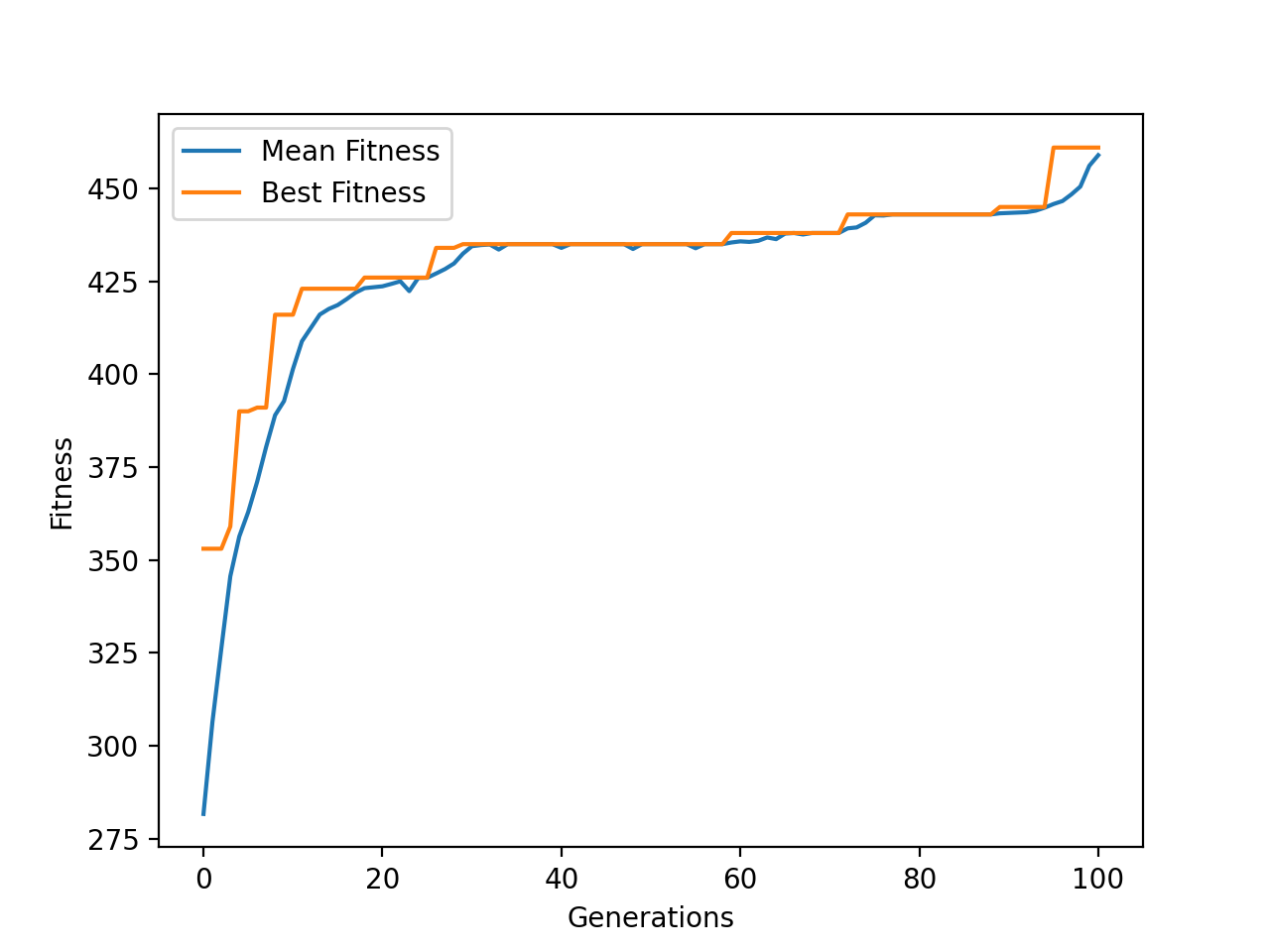
Given several problems with two properties: type and number. Select some elements from them, make sure the sum of the numbers equals to an constant \(M\) and minimize the repetition of types. $\( \min R=\max_t |\{t_i=t,i\in I\}|\\ \sum_{i\in I} n_i=M\\ t_i \in T, n_i \in N \)$ We encode a solution with binary chromosome, that means 0/1 presents to be unselected/selected.
#!/usr/bin/env python3

import numpy as np

from pyrimidine.chromosome import BinaryChromosome
from pyrimidine.population import HOFPopulation

import numpy as np
np.random.seed(6575)


t = np.random.randint(1, 5, 100)
n = np.random.randint(1, 4, 100)

import collections

def max_repeat(x):
    # maximum repetition
    c = collections.Counter(x)
    if c:
        return np.max(list(c.values()))
    else:
        return 0


def _evaluate(x):
    """
    select t_i, n_i from t, n resp.
    the sum of n_i is approx. to a given number,
    and t_i are repeated rarely
    """

    N = abs(np.sum([ni for ni, xi in zip(n, x) if xi==1]) - 30)
    T = max_repeat(ti for ti, xi in zip(t, x) if xi==1)
    return - (N + T*10)


class MyIndividual(BinaryChromosome // 10):

    def _fitness(self):
        return _evaluate(self.decode())


MyPopulation = HOFPopulation[MyIndividual] // 16

pop = MyPopulation.random()
stat = {'Mean Fitness':'mean_fitness', 'Best Fitness':'max_fitness'}
data = pop.evolve(stat=stat, max_iter=50, history=True, verbose=True)

if __name__ == '__main__':

    import matplotlib.pyplot as plt
    fig = plt.figure()
    ax = fig.add_subplot(111)
    data[['Mean Fitness', 'Best Fitness']].plot(ax=ax)
    ax.set_xlabel('Generations')
    ax.set_ylabel('Fitness')
    ax.set_title('Demo for GA')
    plt.show()
Print the statistical results:
iteration & solution & Mean Fitness & Best Fitness & Standard Deviation of Fitnesses & number
-------------------------------------------------------------
0 & 01100010011111010100100110111010001110101100011111 & 243.8 & 302 & 28.589508565206224 & 10
1 & 01100010011111010100100110111010001110101100011111 & 252.71428571428572 & 302 & 23.944664098197542 & 7
2 & 01100010011111010100100110111010001110101100011111 & 278.57142857142856 & 302 & 20.631855694235433 & 7
3 & 01100010011111010100100110111010001110101100011111 & 278.7142857142857 & 302 & 20.526737168276654 & 7
4 & 01100010011111010100100110111010001110101100011111 & 280.14285714285717 & 302 & 20.910889654016373 & 7
...
Example 2
In the following example, the binary chromosomes should be decoded to floats. We recommend digit_converter to handle with it, created by the author for such purpose.
We will use MixedIndividual to encode the threshold for a novel algorithm.
#!/usr/bin/env python3

from pyrimidine.benchmarks.special import *

from pyrimidine import *
from digit_converter import *
# require digit_converter for decoding chromosomes

import numpy as np
np.random.seed(6575)


ndim = 10
def evaluate(x):
    return -rosenbrock(x)


class _Chromosome(BinaryChromosome):
    def decode(self):
        # transform the chromosome to a sequance of 0-1s
        return IntervalConverter(-5,5)(self)


class uChromosome(BinaryChromosome):
    def decode(self):
        return unitIntervalConverter(self)

def _fitness(i):
    return evaluate(i.decode())

_Individual = MultiIndividual[_Chromosome].set_fitness(_fitness) // ndim

class MyIndividual(MixedIndividual[(_Chromosome,)*ndim + (uChromosome,)].set_fitness(_fitness)):
    """My own individual class

    The method `mate` is overriden.
    """
    ranking = None
    threshold = 0.25

    @property
    def threshold(self):
        return self.chromosomes[-1].decode()

    def mate(self, other, mate_prob=None):
        # mate with threshold and ranking
        if other.ranking and self.ranking:
            if self.threshold <= other.ranking:
                if other.threshold <= self.ranking:
                    return super().mate(other, mate_prob=0.95)
                else:
                    mate_prob = 1-other.threshold
                    return super().mate(other, mate_prob)
            else:
                if other.threshold <= self.ranking:
                    mate_prob = 1-self.threshold
                    return super().mate(other, mate_prob=0.95)
                else:
                    mate_prob = 1-(self.threshold+other.threshold)/2
                    return super().mate(other, mate_prob)
        else:
            return super().mate(other)

MyPopulation = StandardPopulation[MyIndividual]
Comparison of Algorithms
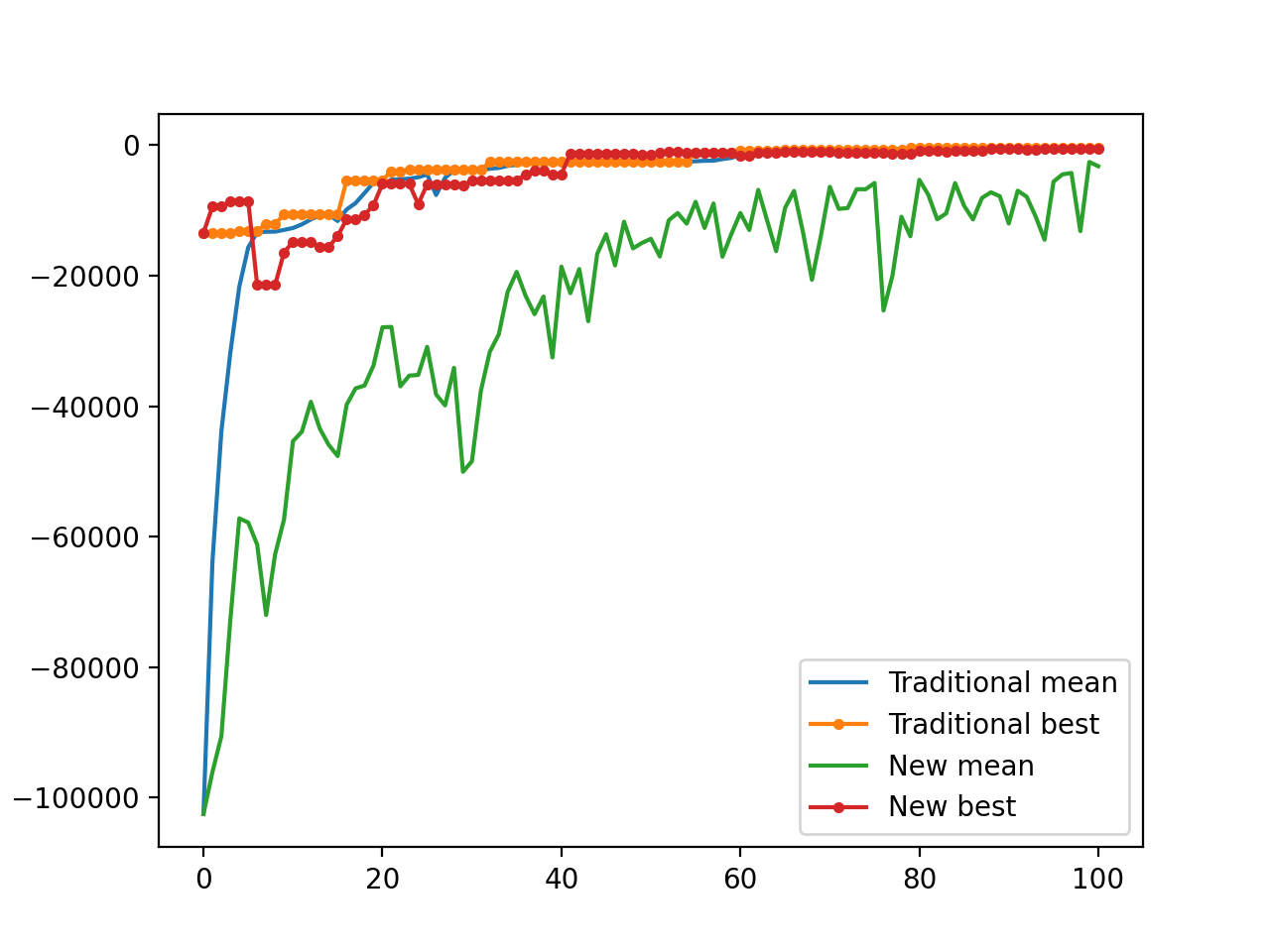
stat = {'Mean Fitness':'mean_fitness', 'Best Fitness': 'max_fitness'}

import matplotlib.pyplot as plt
fig = plt.figure()
ax = fig.add_subplot(111)

_Population = StandardPopulation[_Individual]
pop = MyPopulation.random(n_individuals=20, sizes=[8]*ndim+[8])
cpy = pop.copy(type_=_Population)
d = cpy.evolve(stat=stat, max_iter=100, history=True)
ax.plot(d.index, d['Mean Fitness'], d.index, d['Best Fitness'], '.-')

d = pop.history(max_iter=100, stat=stat, history=True)
ax.plot(d.index, d['Mean Fitness'], d.index, d['Best Fitness'], '.-')
ax.legend(('Traditional mean','Traditional best', 'New mean', 'New best'))
plt.show()
Example 3 — Evolution Strategy
#!/usr/bin/env python

from .base import BasePopulation
from .utils import randint2

import numpy as np
np.random.seed(6575)


class EvolutionStrategy(BasePopulation):
    # Evolution Strategy

    params ={
        "mu" : 10,
        "lambda_": 20,
    }

    def init(self):
        super().init()
        if 'mu' not in self.params:
            self.set_params(mu=self.default_size)

    def transition(self, *args, **kwargs):
        offspring = self.mate()
        self.extend(offspring)
        self.mate()
        self.select_best_individuals(self.mu)

    def mate(self, lambda_=None):
        lambda_ = lambda_ or self.lambda_
        offspring = []
        n = len(self)
        for _ in range(lambda_):
            i, j = randint2(0, n-1)
            child = self[i].cross(self[j])
            offspring.append(child)
        return offspring

    def select_best_individuals(self, mu=None):
        mu = mu or self.mu
        self.individuals = self.get_best_individuals(mu)
#!/usr/bin/env python3

# import statements

n = 15
f = lambda x: -rosenbrock(x)

MyPopulation = EvolutionStrategy[FloatChromosome // n].set_fitness(f)


ind = MyPopulation.random()
data = ind.evolve(max_iter=100, history=True)


import matplotlib.pyplot as plt
fig = plt.figure()
ax = fig.add_subplot(111)
data[['Mean Fitness', 'Best Fitness']].plot(ax=ax)
ax.set_xlabel('Generations')
ax.set_ylabel('Fitness')
ax.set_title('Demo of Evolution Strategy')
plt.show()
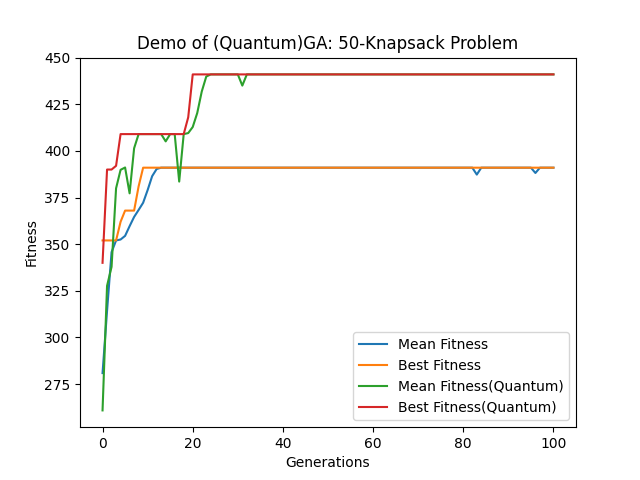
Example 4 — Quantum GA
Here we create Quantum GA.
use QuantumChromosome
Quantum GA is based on quantum chromosomes, QuantumChromosome. Let use have a look at the source code. It is recommended to use decorate @basic_memory to save the best measure result of a quantum chromosome.
class QuantumChromosome(CircleChromosome):

    measure_result = None

    def decode(self):
        self.measure()
        return self.measure_result

    def measure(self):
        # measure a QuantumChromosome to get a binary sequence
        rs = np.random.random(size=(len(self),))
        self.measure_result = np.cos(self) ** 2 > rs
        self.measure_result.astype(np.int_)
Create quantum GA
#!/usr/bin/env python3

# import statements

from pyrimidine.deco import basic_memory, fitness_cache

import numpy as np
np.random.seed(6575)


# generate a knapsack problem randomly
n_bags = 50
evaluate = Knapsack.random(n=n_bags)


@basic_memory
class YourIndividual(BinaryChromosome // n_bags):

    def _fitness(self):
        return evaluate(self.decode())


@basic_memory
class MyIndividual(QuantumChromosome // n_bags):

    def _fitness(self):
        return evaluate(self.decode())


class Population(HOFPopulation):
    default_size = 20

    def backup(self, check=True):
        for i in self:
            i.backup(check=check)

    def update_hall_of_fame(self, *args, **kwargs):
        """
        Update the `hall_of_fame` after each step of evolution
        """
        self.backup()
        super().update_hall_of_fame(*args, **kwargs)


MyPopulation = Population[MyIndividual]
YourPopulation = Population[YourIndividual]
Visualization and comparison
stat={'Mean Fitness': 'mean_fitness', 'Best Fitness': 'max_fitness'}
mypop = MyPopulation.random()
yourpop = YourPopulation([YourIndividual(i.decode()) for i in mypop])

mydata = mypop.evolve(max_iter=100, stat=stat, history=True)
yourdata = yourpop.evolve(max_iter=100, stat=stat, history=True)

import matplotlib.pyplot as plt
fig = plt.figure()
ax = fig.add_subplot(111)
yourdata[['Mean Fitness', 'Best Fitness']].plot(ax=ax)
mydata[['Mean Fitness', 'Best Fitness']].plot(ax=ax)
ax.legend(('Mean Fitness', 'Best Fitness', 'Mean Fitness(Quantum)', 'Best Fitness(Quantum)'))
ax.set_xlabel('Generations')
ax.set_ylabel('Fitness')
ax.set_title(f'Demo of (Quantum)GA: {n_bags}-Knapsack Problem')
plt.show()
Example 5 — MultiPopulation
It is extremely natural to implement multi-population GA by pyrimidine.
#!/usr/bin/env python3

# import statements
# setting the seed

# generate a knapsack problem randomly
n_bags = 100
_evaluate = Knapsack.random(n_bags)

class _Individual(MonoIndividual[BinaryChromosome // n_bags]):

    def decode(self):
        return self[0]

    def _fitness(self):
        return _evaluate(self.decode())


class _Population(HOFPopulation):
    element_class = _Individual
    default_size = 10


class _MultiPopulation(MultiPopulation):
    element_class = _Population
    default_size = 2


mp = _MultiPopulation.random()
data = mp.evolve(max_iter=100, history=True)
Equivalently
#!/usr/bin/env python3

import numpy as np

from pyrimidine import MultiPopulation, HOFPopulation, PolyIndividual, BinaryChromosome
from pyrimidine.benchmarks.optimization import *

import numpy as np
np.random.seed(6575)


# generate a knapsack problem randomly
n_bags = 100
_evaluate = Knapsack.random(n_bags)

_Individual = (BinaryChromosome // n_bags).set_fitness(_evaluate)
_Population = HOFPopulation[_Individual] // 10
_MultiPopulation = MultiPopulation[_Population] // 2

# or in one line elegently,
# _MultiPopulation = MultiPopulation[HOFPopulation[BinaryChromosome // n_bags] // 10].set_fitness(_evaluate) // 2

mp = _MultiPopulation.random()
data = mp.evolve(max_iter=100, history=True)
Plot the fitness curves as usual.
import matplotlib.pyplot as plt
fig = plt.figure()
ax = fig.add_subplot(111)
data[['Mean Fitness', 'Best Fitness']].plot(ax=ax)
ax.set_xlabel('Generations')
ax.set_ylabel('Fitness')
plt.show()
Source code
Following is the core code to implement multi-population where we just introduce migrate method into transition.
class BaseMultiPopulation(PopulationMixin, metaclass=MetaHighContainer):

    element_class = BasePopulation
    default_size = 2

    def migrate(self):
        # exchange the best individules between any two populations

    def transition(self, *args, **kwargs):
        self.migrate()
        for p in self:
            p.transition(*args, **kwargs)
Left the users to think that what will happen, if remove the migrate method.
One can consider higher-order multi-population, the container of multi-populations.
Hybrid-population
It is possible mix the individuals(or chromosomes as the individuals) and populations in the multipopulation (named hybrid-population)
#!/usr/bin/env python3

from random import random
import numpy as np

from pyrimidine import HybridPopulation, HOFPopulation, BinaryChromosome
from pyrimidine.benchmarks.optimization import *

import numpy as np
np.random.seed(6575)


# generate a knapsack problem randomly
n_bags = 100
_evaluate = Knapsack.random(n_bags)

_Individual = (BinaryChromosome // n_bags).set_fitness(_evaluate)


_Population = HOFPopulation[_Individual] // 5


class _HybridPopulation(HybridPopulation[_Population, _Population, _Individual, _Individual]):

    def max_fitness(self):
        # compute maximum fitness for statistics
        return max(self.get_all_fitness())


sp = _HybridPopulation.random()
data = sp.evolve(max_iter=100, history=True)


import matplotlib.pyplot as plt
fig = plt.figure()
ax = fig.add_subplot(111)
data[['Mean Fitness', 'Best Fitness']].plot(ax=ax)
ax.set_xlabel('Generations')
ax.set_ylabel('Fitness')
ax.set_title('Demo of Hybrid Population (Mixed by individuals and populations)')
plt.show()
Exmaple 6 — Game
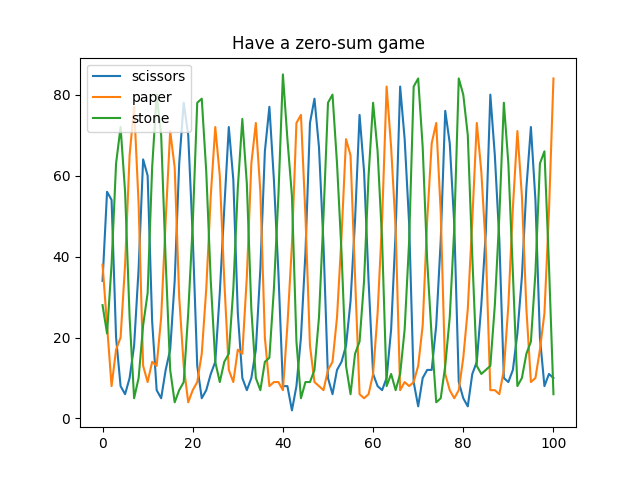
Let’s play the “scissors, paper, stone” game. We do not need fitness here, so just subclass CollectiveMixin, regarded as a Population without fitness.
#!/usr/bin/env python

# import statements


class Player:
    """
    Play the "scissors, paper, stone" game

    `scissors`, `paper`, `stone` = 0, 1, 2
    """

    params = {'mutate_prob': 0.1}

    def __init__(self, strategy=0, score=0):
        self.strategy = strategy # 1,2
        self.score = score

    @classmethod
    def random(cls):
        return cls(strategy=randint(0, 2), score=0)

    def clone(self, *args, **kwargs):
        return self.__class__(self.strategy, self.score)

    def mutate(self):
        self.strategy = randint(0, 2)

    def init(self):
        pass

    def __lt__(self, other):
        return ((self.strategy, other.strategy) == (0, 1)
            or (self.strategy, other.strategy) == (1, 2)
            or (self.strategy, other.strategy) == (2, 0))

    def __str__(self):
        return f'{self.strategy}: {self.score}'


class Game(CollectiveMixin, metaclass=MetaContainer):

    params = {'compete_prob': 0.5, 'mutate_prob': 0.2}

    element_class = Player
    default_size = 100

    def transition(self, *args, **kwargs):
        self.compete()
        self.duplicate()
        self.mutate()

    def mutate(self, mutate_prob=None):
        for player in self:
            if random() < (mutate_prob or self.mutate_prob):
                player.mutate()

    def compete(self):
        k = int(0.5 * self.default_size)
        winner = []
        for i, p in enumerate(self[:-1]):
            for j, q in enumerate(self[:i]):
                if random() < self.compete_prob:
                    if p < q:
                        p.score += 1
                        q.score -= 1
                    elif q < p:
                        p.score -= 1
                        q.score += 1
        winners = np.argsort([p.score for p in self])[-k:]
        self.elements = [self.elements[k] for k in winners]

    def duplicate(self):
        self.extend(self.clone())


game = Game.random()
stat = {'scissors': lambda game: sum(p.strategy==0 for p in game),
'paper': lambda game: sum(p.strategy==1 for p in game),
'stone': lambda game: sum(p.strategy==2 for p in game)
}
data = game.evolve(stat=stat, history=True)

import matplotlib.pyplot as plt
fig = plt.figure()
ax = fig.add_subplot(111)
data[['scissors', 'paper', 'stone']].plot(ax=ax)
ax.set_title("Have a zero-sum game")
plt.show()